
What Are the Best Glasses for Oval Face?

PAGE
By PAGE Editor
So you've got an oval face. Good news — you've hit the genetic jackpot when it comes to eyewear shopping. The balanced proportions of an oval face shape mean you can pull off almost any frame style without looking like you're wearing someone else's glasses. But "almost any" doesn't mean "grab whatever."
Finding the right pair of designer glasses for women or men still requires knowing which shapes play up your features and which ones fall flat. Frame width matters. Lens height matters. And how a specific shape sits against your cheekbones? That matters too. Here's what actually works for oval faces in 2025 — and what to skip.
Key Takeaways
Oval faces work with nearly all frame shapes — your forehead, cheekbones, and chin already sit in proportion
Square, rectangular, and cat-eye frames bring structure to softer facial curves
Frame width should match your cheekbones or extend just slightly wider
Skip oversized frames — they throw off the natural symmetry you've got going
Right now, thin metal frames, retro cat-eyes, and transparent acetate are everywhere
What Makes a Face "Oval"?
Here's the quick test. Your face is longer than it is wide. Your cheekbones sit at the widest point. Your forehead measures slightly wider than your jaw, and your chin rounds off gently rather than coming to a point. Think George Clooney. Julia Roberts. Rihanna. Charlize Theron. That's the template.
Why does this matter for glasses? Because eyewear professionals treat oval as the baseline — the face shape that doesn't fight back against frame choices. Most shapes create a pleasing look rather than clashing with what's already there. You're not trying to balance out a strong jaw or minimize a wide forehead. You're working with proportions that already cooperate.
The goal when picking glasses for oval faces comes down to one question: do you want to maintain that natural balance, or add some edge? Straight lines from rectangles add structure. Curved frames layer shape on shape. Both approaches work. It's really about what you're going for.
Best Frame Styles for Oval Faces
Square and Rectangular Frames
Square glasses and rectangular frames do something specific for oval faces — they introduce angles where there aren't any. Your face has soft curves. These frames have sharp corners. The contrast reads as polished. Professional. Put-together.
Rectangle frames pull attention toward your eyes and cheekbones. They project a certain authority. Not in an aggressive way — more like quiet confidence. Men and women both benefit here, though narrower rectangles tend to read more feminine while wider ones skew bold.

Cat-Eye Glasses
Cat-eye glasses have been around since the 1930s. They're still here for a reason.
The upswept corners do two things at once. They accentuate cheekbones — already a strong feature on oval faces — and they lift the visual focus upward. Drama without trying too hard. You can go subtle with gently raised corners or full vintage with pronounced wings. Oval proportions handle both extremes.
One thing worth noting: cat-eyes don't have to mean "retro secretary." Plenty of modern interpretations exist. Thinner frames. Unexpected colors. Angular rather than rounded bases.
Aviator Eyeglasses
Aviator glasses started as functional gear for pilots back in the 1930s. Now they're a style staple that happens to work really well with oval faces.
The teardrop lenses extend vertically across your face. The brow bar adds a horizontal anchor at the top. Metal aviators with vintage details rank among this year's top trends. And unlike some frame styles, aviators translate well from prescription glasses to sunglasses without losing their impact.
Round Frames
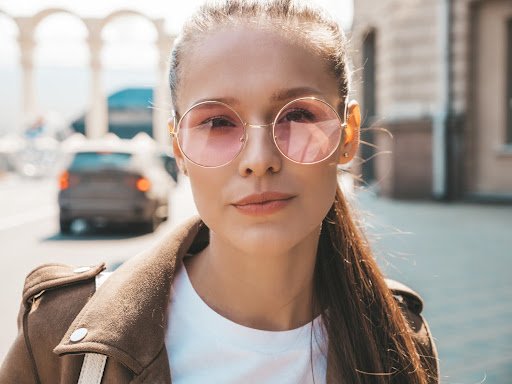
Here's where oval faces have an advantage others don't. Round glasses on a round face? Risky. Round glasses on an oval face? It works.
The circular shape layers curve on curve, but the scale difference keeps things interesting. Round frames read studious. Approachable. Intellectual without being stuffy. K-drama and K-pop have pushed their popularity recently, and the style shows no signs of fading.
One caveat: stick with narrower rounds. Oversized circles overwhelm rather than complement. You want balance, not a statement piece that swallows your face.
Browline and Geometric Frames
Browline glasses have that thick upper rim — bold at the brow, minimal below. Malcolm X wore them. So did JFK. The style projects intellectual weight without feeling dated.
Geometric frames — hexagons, octagons, irregular shapes — bring something different. They're modern. A little unexpected. And because oval faces don't fight angular shapes, you can experiment here without worrying about harsh contrasts.
Frame Sizing and Fit
A frame can be the right shape and still look wrong. Fit matters.
Prescription glasses should sit level on your face. Your eyes belong in the center of each lens — not too high, not too low. Frame width should match the widest part of your face (cheekbones, for most oval shapes) or extend just slightly beyond. Go too narrow and your face looks wider than it is. Go too wide and you lose that balanced look you're starting with.
Measurements That Actually Matter
Lens width runs 40-60mm for most frames — that's the horizontal measurement across each lens
Bridge width (14-24mm) determines how the frame sits on your nose
Temple length (120-150mm) affects how the arms fit behind your ears
Frame width overall should leave no more than a finger's width between the temple and your face
If you're shopping for bifocals or progressives, pay attention to lens height. You need at least 30mm to fit all the visual zones properly. Less than that and you're compromising function for style.
Virtual try-on tools help when you're buying online. They're not perfect, but they'll flag obvious mismatches. For precise fitting — especially with multifocal lenses — an optician visit saves headaches later.

What to Skip
Oval faces have flexibility. Not unlimited flexibility. A few styles tend to miss the mark:
Oversized frames overwhelm balanced proportions — your face ends up looking smaller or narrower than it actually is
Frames much narrower than your face width create an awkward pinched effect
Large circular frames with thick rims can blur your features rather than define them
Heavy nose bridges compress the middle of your face visually
These aren't hard rules. Someone somewhere makes every style work. But if you're shopping efficiently, these are the categories to approach with skepticism.
2025 Trends Worth Knowing
Thin metal frames dominate professional settings right now. Lightweight. Understated. They let your face do the talking rather than competing for attention.
Transparent acetate has moved beyond clear into rose, sky blue, amber, and other soft tones. The look pairs with almost anything and works across skin tones.
Cat-eye styles keep evolving. This year's versions range from dramatic upswept corners to barely-there lifts. Bold colors have momentum too — not just safe neutrals. Honey tones. Deep amber. Chocolate browns.
Gold and rose-gold metal finishes add subtle warmth. Clubmaster-style frames have circled back into relevance, mixing vintage structure with cleaner lines.

Shopping Smart
Match frame width to your cheekbones. That's the foundation.
Think about context. Classic shapes suit professional environments. Casual settings open room for bolder experiments. Most people benefit from owning both.
Virtual try-on tools give you a preview. They won't replace trying frames physically, but they'll narrow your options before you commit. Know your pupillary distance before ordering online — incorrect PD throws off how lenses sit relative to your eyes.
For progressive or bifocal wearers, schedule an optician fitting. The measurements get more precise, and the stakes for getting it wrong go up.
Color matters more than people realize. Warm skin tones pair well with gold, tortoiseshell, and amber frames. Cooler skin tones lean toward silver, black, and blue-toned options. When in doubt, try both and trust your gut.
The best glasses for oval face shapes come down to what you actually want. Your proportions give you options most face shapes don't have. Use that freedom. Try shapes you wouldn't expect to like. Skip the ones that feel off, even if they're "supposed" to work. The right frames make you reach for them every morning without thinking twice.
HOW DO YOU FEEL ABOUT FASHION?
COMMENT OR TAKE OUR PAGE READER SURVEY
Featured




Walking into a CBD store for the first time can feel overwhelming.