
The Anatomy of an Algorithm: How Computers "Think"

PAGE
By PAGE Editor
Algorithms might sound mysterious at first, but they are simply sets of clear, step-by-step instructions designed to solve problems or complete tasks—much like a recipe in cooking. Think about your favourite recipe: it lists ingredients and then provides a series of steps to make a meal. Just as you follow these directions to cook dinner, computers follow algorithms to process data and perform operations efficiently and accurately.
Fundamental Qualities of Well-Designed Algorithms
Key features of all good algorithms include:
Clarity: Each step must be easy to understand and unambiguous, so the process never confuses the computer or programmer. Just as a recipe can’t say “add some sugar” without specifying how much, algorithms demand precise instructions.
Finiteness: An algorithm must have a clear endpoint. It won’t loop on forever but will stop after completing its task. Imagine if your recipe told you to “keep stirring endlessly” — you’d never get anywhere!
Executability: Every step in an algorithm must be something that can actually be done, with no vague guidance. For example, “choose a number” is fine if further instructions are also clear.
Inputs and outputs: Algorithms always start with some input (ingredients or data) and result in an output (a finished meal or sorted data).
Determinism: Given the same inputs, the algorithm must always produce the same outputs, ensuring consistent and predictable results.
Algorithms are everywhere in everyday life beyond computers. You follow algorithms when you follow a map’s directions or play a board game—with set rules defining your next moves. In technology, businesses such as https://fortunica3.com/en-gb rely on algorithms to keep their games fair and handle complex data securely.
Some common algorithmic tasks you may encounter daily include:
Sorting a list of exam scores from highest to lowest.
Searching a dictionary or phonebook for a name.
Calculating the total cost of items in an online shopping cart.
Validating a password during login to a website.
These examples show how algorithms organise steps logically to solve problems both for humans and machines.
How Algorithms Operate: Steps and Types
At a basic level, algorithms follow a standard process of four key steps. First, they receive input data, such as a list of numbers or words. Next, they process this information through a series of logical operations, transforming or analysing the data as needed. Then, they perform decision-making, using conditional checks or loops that repeat steps until a goal is met. Finally, the algorithm produces the output, whether it’s an organised list, a calculated value, or a decision.
For example, consider sorting your playlist songs alphabetically. The unsorted list is the input. The algorithm compares and rearranges song titles step by step during processing. It continuously checks if the list is sorted; if not, it repeats the steps (the decision point). Once sorted, the algorithm outputs the alphabetically ordered playlist.
Algorithms come in many forms, each suited for different challenges. Here are some common types and their practical uses:
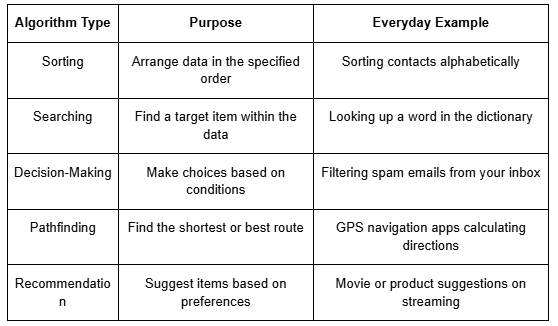
Among beginner-friendly algorithms are:
Linear search: Checking each item one by one until the target is found.
Bubble sort: Repeatedly swapping adjacent items to sort a list.
Binary search: Efficiently finding a value in a sorted list by halving the search area at each step.
Dijkstra’s algorithm: Calculating shortest paths in maps or networks.
Different algorithms vary in speed and complexity. Some are straightforward but slow on large data, while others use clever shortcuts to be fast and efficient.
Why Algorithms Matter and How to Think Algorithmically
Algorithms power almost every digital tool we depend on:
Search engines quickly sift through vast amounts of data to find relevant information.
Secure online banking and gaming platforms use algorithms to validate transactions and maintain fairness.
Social media feeds, email filters, and streaming platform recommendations all rely on algorithms to personalise your experience.
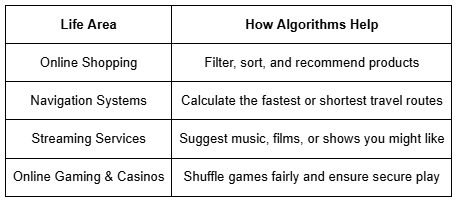
For beginners, learning to think algorithmically means training oneself to break problems down into clear, logical steps. This is a valuable skill not only for programming but also for everyday problem-solving.
Here are some practical ways to build algorithmic thinking:
Break down complex problems into small, manageable parts.
Use flowcharts or diagrams to visualise each step and decision.
Practice “if/then” logic to handle different scenarios.
Test your steps by imagining how they’ll work in real situations.
Try simple exercises such as writing step-by-step instructions for making a sandwich, sorting playing cards with bubble sort, or mapping your morning routine in a flowchart. These activities help build the habit of structured, computational thought.
Unlocking the Power of Algorithms
Though algorithms may seem complex at first, they are essentially logical recipes—ordered, precise instructions that guide both people and machines through problems. For tech-curious beginners and students, grasping algorithms opens the door to understanding much of the digital world and enhances problem-solving skills.
Why not take the first step today? Pick a familiar daily task and try writing your own algorithm for it. Share your creations or questions in the comments below, and join others on the path of discovering how computers—and people—think step by step.
HOW DO YOU FEEL ABOUT FASHION?
COMMENT OR TAKE OUR PAGE READER SURVEY
Featured





The road culture of Calgary is impacted by a variety of factors. Industrial hauling, daily commuting, long stretches of highway, and winter driving can often leave a mechanical imprint on the trucks.