
The Evolution of Battery Technology: What It Means for Hunting E-Bikes
PAGE
By PAGE Editor
In the last decade, electric bikes have moved from city streets to rugged backwoods, transforming how people approach outdoor travel and sports. Nowhere is this shift more apparent than in the growing popularity of electric hunting bikes—e-bikes designed specifically for use in forested, uneven, and often remote terrains. One of the biggest forces behind their improved utility and performance? The steady evolution of battery technology.
This article explores how recent advancements in battery design, capacity, and charging systems are shaping the real-world capabilities of electric bikes used for hunting, trail riding, and utility work. From dual motor electric bikes designed for hills and mud to electric beach cruisers adapted for quiet waterfowl hunts, battery improvements are expanding what these machines can do.
Why Battery Technology Matters for Hunting E-Bikes
Unlike urban e-bikes, which benefit from well-developed infrastructure, hunting e-bikes often operate in remote areas where charging options are limited and terrain is unpredictable. That means batteries need to deliver:
Long-range performance across varied elevation
Reliable power output for throttle- or pedal-assisted climbs
Sufficient watt-hour capacity to support cargo or gear trailers
Minimal downtime between charges
As outdoor adventurers and hunters rely more heavily on electric equipment, battery improvements are not just desirable—they’re essential.
A Brief Look at E-Bike Battery Evolution
Then: Lead-Acid and Nickel-Cadmium
Early e-bikes relied on sealed lead-acid (SLA) batteries. Though affordable, these were heavy, bulky, and had limited lifespans—especially in cold weather. Some mid-era bikes also experimented with nickel-cadmium (NiCd) cells, which offered better power density but introduced environmental concerns due to cadmium toxicity.
Now: Lithium-Ion Becomes the Standard
Today’s electric hunting bikes and off road electric bikes nearly all run on lithium-ion (Li-ion) batteries. Compared to previous battery types, lithium-ion delivers:
Higher energy density (more power in a smaller package)
Longer cycle life (typically 800–1,000 charge cycles)
Lower weight, improving bike balance and efficiency
Better temperature tolerance, critical for cold-weather hunts
Watt-Hours, Voltage, and Range: What’s Changed?
Watt-Hours (Wh): The True Measure of Range
Battery capacity is often measured in watt-hours, which reflects how much power a battery can deliver over time. In hunting applications, a higher Wh rating typically means longer rides without recharge.
Older models (2010–2015): ~400–500 Wh
Modern hunting e-bikes (2024): ~750–1,200 Wh or more
Dual battery systems: Some setups exceed 1,500 Wh total
This increase allows a rider to cover 35–75 miles on a single charge, depending on weight, incline, speed, and pedal-assist usage.
Voltage and Torque
Modern dual motor electric bikes use 48V or even 52V systems, which deliver higher torque output—especially useful for climbing hills while towing game or gear. Voltage consistency also ensures smoother throttle response and less drop-off in hilly terrain.
The Rise of Modular and Swappable Battery Systems
Another major leap has come in the design and accessibility of battery systems.
Removable Batteries
Most electric beach cruisers and hunting electric bikes today feature removable lithium-ion batteries that can be charged off the frame. This is crucial for:
Hunters who need to charge indoors or via portable power stations
Campsites without grid access
Swapping packs in the field for extended trips
Dual-Battery Support
Brands like Bakcou, QuietKat, and Rambo now offer dual battery options, doubling range without sacrificing cargo space. This is especially helpful for multi-day expeditions or hauling heavy loads over varied terrain.
Battery Management Systems (BMS) and Performance Reliability
Battery life is about more than capacity. Modern batteries include smart battery management systems (BMS) that:
Prevent overcharging or overheating
Regulate output under stress (e.g., hill climbing)
Monitor cell health to extend lifespan
In the field, this translates into more reliable starts, better power delivery consistency, and longer usable battery life—essential for off road electric bikes tackling muddy trails or sudden inclines.
Solar Charging and Off-Grid Hunting
As backcountry users seek energy independence, solar charging systems have entered the picture.
Foldable solar mats compatible with Li-ion chargers
Power banks or generators that serve multiple devices (e.g., bike + GPS + lights)
8–12 hour solar charging for a full battery on sunny days
While not yet the norm, solar charging is increasingly used to supplement trips over several days—especially when paired with dual motor e-bikes that consume more energy.
Thermal Performance: Hunting in Cold Climates
Hunters know that battery performance drops in cold weather—sometimes by 20–40%. Advances in cell chemistry and thermal protection now allow:
Battery warming sleeves or covers
Auto-regulating discharge control to prevent power spikes
Cold-weather-tested cells that perform more consistently below freezing
These improvements are essential for big-game hunters or anyone using electric hunting bikes during early-morning or late-season trips.
8. Impacts on Weight and Handling
With better energy density, today’s batteries pack more power without dramatically increasing weight.
Example:
500Wh Li-ion battery: ~6.5 lbs
1,000Wh Li-ion battery: ~8.5–9 lbs (with improved materials)
That’s a manageable addition to most off road electric bikes. Furthermore, center-mounted batteries help distribute weight evenly, improving bike handling in technical terrain.
Safety and Battery Certification
As battery power increases, safety and regulatory compliance become more important:
UL 2271 and UL 2849 standards certify e-bike battery safety and electrical systems
Brands focused on electric beach cruiser and dual motor electric bike categories increasingly highlight compliance for retail partnerships and consumer trust
This also helps prevent battery swelling, thermal runaway, and voltage-related faults—concerns that used to be more common in early e-bike designs.
Market Examples: Brands Leading in Battery Innovation
Several outdoor e-bike brands have embraced advanced battery systems in their hunting and trail-focused models:
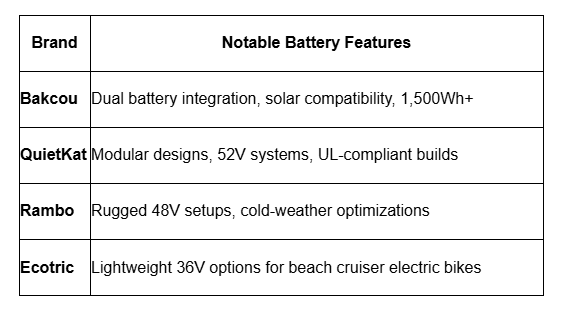
These improvements are making electric hunting bikes more viable across multiple environments—from coastal wetlands to mountain trails.
Future Trends in E-Bike Battery Technology
As outdoor mobility continues to evolve, so will battery capabilities. We can expect:
Solid-state lithium: Promises even greater energy density and fire resistance
Faster charging: Full charge in under 2 hours using 4A+ chargers
AI-based BMS: Adaptive systems that learn user behavior to optimize discharge
Recyclable battery packs: Sustainability gains with modular component replacements
These will particularly benefit outdoor e-bike users, where flexibility and long-term performance matter more than flashy features.
Conclusion: Better Batteries, Better Backcountry Access
The progress of battery technology has transformed electric hunting bikes from a novelty into a serious tool for backcountry access, wildlife observation, and all-season mobility. Improved capacity, thermal stability, recharge options, and smarter battery management systems all contribute to making today’s bikes more practical and dependable.
Whether you're exploring flat coastal areas with an electric beach cruiser, hauling gear through snow with a fat tire dual motor e-bike, or riding deep into the forest for a multi-day hunt, battery technology will increasingly define how far—and how effectively—you can go.
HOW DO YOU FEEL ABOUT FASHION?
COMMENT OR TAKE OUR PAGE READER SURVEY
Featured





When investing in quartz countertops, choosing the right warranty and care package is just as important as selecting the color and finish.