
Goddess Jewelry: How Symbolic Adornments Empower Modern Women
PAGE
By PAGE Editor
Goddess Jewelry: Symbol, Dialogue, and the Making of Meaning
Goddess jewelry is not just an ornament; it carries stories, power, and symbolism. Across cultures, Women have used ornaments to connect with the divine power, celebrate femininity, and express personal authority. These pieces usually have symbols same like the moon, lotus, or sacred geometry, which represent strength, intuition, and transformation.
In today’s modern world, Goddess jewelry is a blend of tradition and self-expression. The items that women wear are the ones that replicate their inner experience, creating a quiet conversation between the wearer and the outside world. Rings, bracelets, and pendants all serve as a declaration of identity, self-assurance, and intention.
Other than beauty, these items enable women to be strong, admire their intuition, and embrace individuality. Women can intentionally wear their jewelry by understanding the meaning and history of each piece, transforming simple items into meaningful expressions of their values and spirits.
Goddess jewelry is not merely an art; it is a depiction of the strong, modern woman.
I. Symbol as Expression: Why Humans Turn Values into Visible Forms
The Origin of Symbolic Adornment
Long ago, humans used objects to convey meaning. Early communities in Mesopotamia, Ancient Egypt, and the Indus Valley wore engraved badges, amulets, crowns, and rings. They weren't just ornaments. They brought hope, faithfulness, hierarchy, and prayer.
Before the systematic language, there were symbols. Perhaps a stone head was a sign of protection. A circlet could proclaim an authority. A ring could offer loyalty. Communities used sight and touch to recognize shared values.
Symbolic ornamentation is the act of connecting objects worn on the body with abstract values, like safety, authority, and community. It fixes belief into shape and makes the unseen visible. For example, a crown or pendant is a declaration of invisible faith.
This is the core human logic. Human beings fix their inner beliefs with visible objects. By wearing a jewelry item, they transform belief into reality and give it a lasting, personal touch.
Myth Is Not a Distant Story, but a Psychological Structure
Myth does not exist just in the past. It lives in the human mind. The figures of ancient times are psychological archetypes. They are reflections of inner forces, fears, and abilities. According to most religions, gods are representations of what is possible to think of and how it should be done, and these ideas are passed down through the generations.
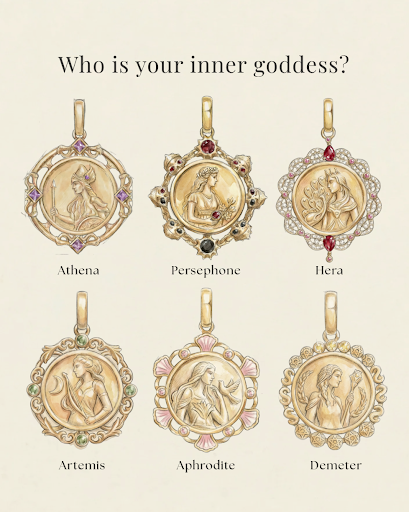
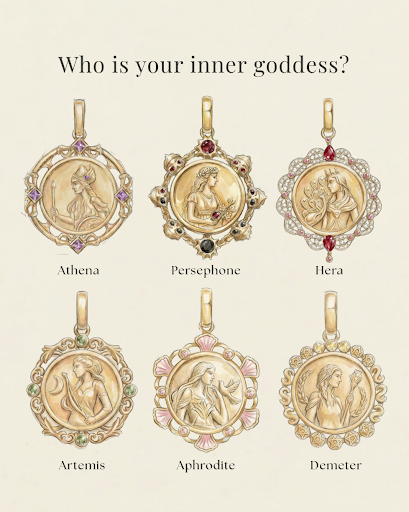
Consider Athena. She symbolizes wisdom, tact, and disciplined valor. Think of Artemis. She is autonomous, intuitive, and defensive. These are not all fantastical figures. They are symbolic representations of forces that lots of women are aware of in themselves.
A myth is a type of psychological arrangement. A story personifies feelings and instincts that occur in everyday life, creating a map of the human psyche. Therefore, symbols are the external expressions of the inner energy. They are a form of identity assertion.
Because myth traces human psychology rather than history, it transcends time. It addresses those feelings that don't change despite cultural shifts.
Adornment as a Declaration of Identity
With time, ornamentation molds more than appearance. It shapes identity. The wearing process is never neutral. Each of the chosen symbols participates in self-construction. It expresses a silent story about values, boundaries, and traditions.
Throughout history, women have used symbols to express their status and authority. In ancient Rome, certain rings served as symbols of loyalty and status. Beads were used to symbolize status and ancestry in West Africa. These ornaments weren't dormant. They were obvious symbols of authority and membership.
When anticipation is replaced with determination, ornament becomes a declaration. What is placed on the body can either declare one's self-definition or reinforce it. Observation is one thing, but being vocal is quite another. One accepts labels from other people. The other is the internal truth.
Symbols become statements about those women once they enter social space. They transform the shared discourse from the privatized meaning. Identity is affirmed through them.
II. Symbol in Dialogue: The Three Relational Dimensions of Female Experience
The Gaze of the Other: Expression within Social Space
Ornamentation is not something secret. The time when it is worn and enters a social setting, it meets the gaze of others. A necklace, ring, or emblem might be visible in common social gatherings. Then, meaning is read, interpreted, and judged at times.
In many historical periods, such as Victorian England and Imperial China, the dress code defined the perception of women. In general, ornaments tended to support social roles. Gaze contributed to the structure's preservation.
However, symbols can also be used to remake that structure. When a woman chooses her symbol intentionally, she moves the narrative in a different direction. Wearing causes penetration into the eye. The gaze constitutes social meaning. Thus, by choosing a different interpretation, the structure can be changed.
Public visibility brings adornment into the public's view. Jurisdiction is regained when the meaning is not forced, but it is chosen by the wearer. In the social field, she is treated as an object rather than a subject.
Woman to Woman: Transmission and Shared Meaning
Jewelry frequently passes through the hands of women. A ring is given to a daughter by her mother. A friend gives a pendant as a gift during a transition. A grandmother left behind a bracelet filled with memories. In most cultures, including South Asian cultures and Eastern Europe, such transfers are blessed and continued.
Jewels multiply when they are passed from one woman to another. What was once personal identity is now relationship validation. The item contains two or three and a half stories. It collects communal intention, memory, and trust.
Symbols spread via communication. They acquire a second meaning in new circumstances. Something that was put on as a sign of bravery can be used in the future as a symbol of unity. A necklace that was initially tied to sorrow can be used to signify strength.
This exchange transforms etiquette into dialogue. Between the giver and taker, there is a lack of appreciation. It's a discreet form of aid. Women support each other with their experience and empower invisible ties through mutual symbols.
Body Memory Precedes Language
Before the human mind learns the words, the body stores the memory. Repetitive behavior leaves a trace of knowledge before words specify an opinion. Wearing a pendant, fastening a bracelet, or massaging a charm into the skin or muscle gives the body a conscious intention.
Formalized decoration is a way to strengthen ties to history, values, and meaning. Through this repetition, abstract symbols take the meat of the flesh. A ring is more than just a piece of metal; it can also represent courage, loyalty, or protection. A pendant is more than just a decorative piece; it is a symbol of memory or hope. The body has a memory that guides thought, emotion, and choice.
Identity building occurs through performance. One's typical clothing, gestures, and posturing all influence how they live in the world. Language alone is not enough to build beliefs; the body also plays a role.
Identity becomes a lived reality rather than a theory when the self is expressed through physical ritual. Wearing jewelry becomes a real-time rehearsal, memorization, and confirmation process.
Self to Self: The Private Ritual of Identity
Adornment can be a private dialogue. It is a micro-ritual and a self-affirmation to wear it every day. Choosing a ring, bracelet, or pendant each morning serves to remind a woman of her goals and ethics.
In terms of psychology, these rituals serve as anchors. Women feel calmer and have more confidence and mental focus. The familiar symbols provide continuity as a shift or uncertainty of circumstances approaches. Their purpose is to remind the wearer of her own strength, resilience, and purpose.
Identity is played out repeatedly. Jewelry has a deeper meaning than only decorating the body. The dialogue between a woman and herself is where the symbols are recalled. Ceremony, recollection, and confirmation are ornaments in this intimate relationship. It guarantees that, despite life's storms, the wearer remains rooted, consistent, and empowered without disruption.
III. Meaning in Accumulation: How Power Condenses into Jewelry
From Object to Vessel: The Layering of Experience
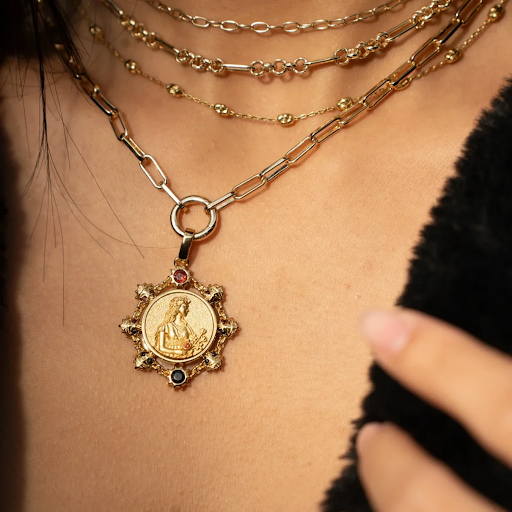
Jewelry is more than a decoration when it has a living experience. On a single object, when emotion and time overlap, social expressiveness, inter-female transfer, and physiological memory come together. A pendant may be used to remember the wearer's courage, a companion's blessing, or even the customs of daily life.
In such connections, objects become experience vessels. The touch, the gift, and the repeated wearing all bring some new meaning. The content conveys intent, memory, and shared narrative.
Power is also tied to objects and shows up in relationships. In matter, meaning condenses. It transforms from a simple ornament into a source of history, affiliation, and identity. As a physical item that may preserve human experience over time, jewelry is both social and personal.
Stability in a Fluid World
A modern woman's identity is dynamic and shaped by a variety of roles, environments, and demands. It is impossible to stop the state of change, and self-definition is often ambiguous. Body art serves as anchors in this changing landscape.
Jewelry turns into continuity. A pendant, bracelet, or ring serves as a reminder to the woman of her intentions, strength, and values. Wearing it every day stabilizes the ego and acts as a silent anchor to all the external confusion.
Identification is verified by using decoration through choice. In spite of the shifting conditions, it gives the wearer a personal connection. Symbols have space to stand up, defend, and philosophize.
Especially in an ever-changing society, these tangible reminders help women stay focused, stay coherent, and maintain a sense of self that endures through life transitions and reorientations.
Empowerment as Meaning-Making
Empowerment is developed via meaning, not by an object. Jewelry itself doesn't generate power. Instead, it condenses the experience, the intention, and the belief into a tangible form. A ring or pendant is a physical representation of an underlying belief.
Symbols serve as communication tools. They engage in connections and initiate conversations with others and with themselves. This triple exchange of the self, social environment, and relationship net creates layers of meaning.
Meaning is developed, and resilience, self-assurance, and purpose are reinforced through these relationships. A living symbol is created when an object absorbs energy that already exists in the wearer.
In this case, adornment helps women grow by providing them with not only beauty but also a structured, useful, and supportive avenue for expressing who they are and building their own strength.
HOW DO YOU FEEL ABOUT FASHION?
COMMENT OR TAKE OUR PAGE READER SURVEY
Featured



When you book a luxury car service in Orlando, you are not simply arranging transportation.