
How PODpartner Turns “DTG + Embroidery” from Risk into Premium
PAGE
By PAGE Editor
Introduction
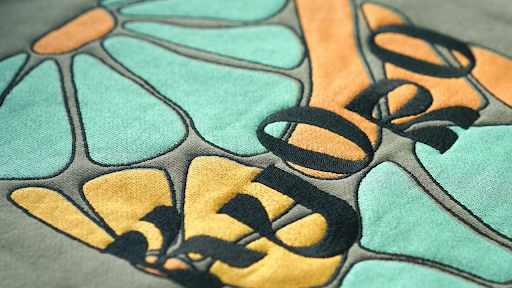
Over the past two years, the hybrid technique combining DTG (Direct-to-Garment) printing with embroidery has moved from niche experimentation to a standard option among high-end streetwear and lifestyle brands. The reason is straightforward: digital printing delivers saturated color and visual freedom, while embroidery offers dimensional tactility and a sense of craftsmanship. Yet the industry consensus is clear—this is hard to execute. Alignment errors, fabric deformation, process interference, and human-machine coordination can turn great creative ideas into subpar products at any stage.
In recent research, we identified a POD-mode operator—PODpartner—that has developed a relatively systematic solution in this domain. The analysis below breaks down the key elements of their methodology, how it differs from common industry practice, where it likely applies, and what it means for brands in practical terms.
The Real Scale of Industry Pain Points: From “Align Well” to “Stay Stable”
Alignment isn’t guesswork: Even minor offsets between the DTG graphic and subsequent embroidery (often occurring after heat curing and re-hooping) can produce visible “off-boundary” stitching. Traditional reliance on visual alignment and manual hooping often fails under batch production and repeat orders.
Fabric stability is the core variable: Heavyweight 100% cotton, after pre-treatment and high-temperature curing, undergoes micro-scale fiber shrinkage and rigidity changes that combine with embroidery tension to cause puckering and shape distortion. An unstable base fabric dramatically increases risk when layering processes.
Non-linear workflow brings consistency challenges: From pre-treatment to curing to embroidery and final inspection, any timing deviation, parameter fluctuation, or handoff error expands tolerances and heightens scrap rates. This non-linearity is the essence of hybrid complexity compared to single-process operations.
PODpartner’s Methodology: Turning “Perceived Risk” into “Controllable Tolerance”
Based on available materials and case interviews, PODpartner’s approach centers on three paths: digital alignment, textile engineering parameterization, and end-to-end SOPs with QC gates.
1. Digitization and Machine Vision: Elevating alignment from “craft mastery” to “system capability”
Pre-production simulation: DTG files and embroidery digitization are mapped onto the same garment template in 3D to expose overlap risks and boundary issues upfront. The value here is shifting error detection to a “zero-fabric” phase.
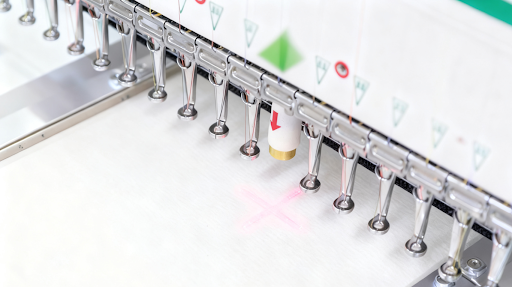
Registration marks and optical recognition: Embedding alignment marks into the DTG file that are read by embroidery equipment sensors during hooping, enabling micro-adjust compensation. Compared to grid snapping or cross-hair alignment, machine vision is more robust against slight fabric stretch or shrinkage.
Explicit alignment tolerance: Delivering to a ≤5mm positional tolerance with full records. It’s not the only industry benchmark, but it meets the perceptual threshold of high-street retail quality.
In our view, this digital pathway’s value lies in converting “alignment” from tacit craft knowledge into explicit parameters and device coordination—enabling repeatability across
2. Textile Engineering Perspective: Using materials databases and dynamic tension to become “anti-fragile”
Fabric–process matching: Using fabric weight (e.g., 300gsm), structure, and historical data to determine pre-treatment saturation, curing temperature window, and embroidery tension plans. A database-driven parameter selection reduces trial-and-error cost.
Dynamic tension control: Combining hoop pressure, stitch density, thread tension, and stabilizers to build an “anti-puckering” strategy for different cotton grades. This transforms mechanical disturbance from “post-hoc correction” into “preemptive suppression.”
Redefining roles and capabilities: Merging “pattern makers” and “process engineers” into hybrid roles encompassing textile engineering and digital digitizing, reducing information silos and error accumulation.
From an industry comparison standpoint, the barrier here is long-term sampling and iterative discipline. Databases aren’t built overnight; they require continuous volume production and rigorous record-keeping.
3. SOPs and Multi-Gate QC: Creating scalable discipline for complexity
Defined process cadence and handoff protocols: Ensuring consistency in timing and environment from curing to hooping to reduce “soft variables.”
Three QC gates: Post-print, pre-embroidery, and post-finishing checkpoints respectively validate color accuracy, alignment recognition, and absence of puckering/deformation. The point of multiple gates isn’t just “stricter,” it’s “earlier detection and lower-cost correction.”
Immutable production records: Retaining equipment parameters, simulation outputs, and QC imagery to support after-sales, reorders, and process optimization with a clear evidentiary chain.
4. Differences from Common Practice and Practical Boundaries
Differentiator: PODpartner has engineered both “alignment” and “stability” simultaneously, forming a replicable hybrid process chain. It’s not just “can do,” but “can consistently do,” which is uncommon among small-to-mid POD factories.
Cost dimension: Digital preflight, sensor-based recognition, and multi-gate QC inevitably add upfront cost and lead time, but for brands pursuing higher AOV and lower return rates, this often optimizes total cost.
Applicability boundaries: The approach is most targeted to heavyweight cotton. Switching to elastane or synthetic blends requires rebuilding parameters. For ultra-fine embroidery details or DTG with high coverage (large deep-color blocks), case-by-case evaluation is still needed.
Risk note: Over-reliance on visible registration marks may affect design aesthetics; early-stage pattern work should incorporate “hidden markers” and positional optimization.
What It Means for Brands: Turning “Detail Strength” into “Brand Strength”
Premium logic: When alignment and flatness are consistently delivered, consumers’ subjective judgment of “craft quality” rises, and they are willing to pay for tactility and durability.
R&D–marketing synergy: With controllable hybrid processes, design teams can more boldly use outline embroidery, localized relief, and layered imagery, widening aesthetic differentiation at the same price tier.
Supply chain trust: Traceable production records and clear tolerance standards enable brands to draft stronger quality clauses and after-sales frameworks, reducing ambiguity.
Conclusion
The DTG + embroidery hybrid is not a “novel trick” but a stress test of supply chain competence. Our observation is that PODpartner, through digital alignment, a materials-parameter database, and multi-gate QC, has turned a “high-risk zone” into a “replicable advantage zone.” For brands seeking texture and differentiation, this means not only more stable delivery of “good-looking” products, but also sustained reputations for “comfortable and durable.”
In a market where category status is decided by details, the suppliers who can convert complexity into stability are often the ones who can convert stability into brand assets. PODpartner offers a compelling blueprint, but the true moat lies in ongoing database construction and process discipline—this is the industry’s future dividing line.
HOW DO YOU FEEL ABOUT FASHION?
COMMENT OR TAKE OUR PAGE READER SURVEY
Featured





The OTW by Vans x Parra Old Skool 36 marks a full-circle collaboration that fuses Parra’s surreal, minimalist artistry with Vans’ skate heritage, reimagining an iconic silhouette through thoughtful design, premium materials, and cultural authenticity.