
Islamic Heritage and Archaeological Significance of Tabuk
PAGE
By PAGE Editor
Tabuk is located in the north-western part of the Holy land and is a breathtaking place to visit as you can explore the mountainous blends with huge deserts and exclusive green valleys. This is a strategic crossroads that has linked continents through centuries, which has been a crucial route in the ancient trade caravans and the ancient armies. However, Tabuk is much more than a modern administrative center; it is a museum where Islamic religion mixes with ancient archeology.
Tabuk has become one of the key destinations where cultural travellers can find authenticity as Saudi Arabia opens its borders to international tourism. If you are planning to perform a visit to Saudia with exclusive Umrah performance then it is advised to select Umrah packages 2026 for a comfortable yet advanced visit. This is a special place, which retains the traces of the deepest spiritual values and remains of the civilisation that existed many centuries ago. It is a significant episode in the history of the Middle East.
The identity of Tabuk is established in the history of the Islamic religion, giving spiritual seekers a strong link to the early years of the religion.
Ghazwat Tabuk: The Pivotal Campaign that Shaped Islamic History
The biggest Muslim army led by Prophet Muhammad (PBUH) was dispatched northwards in the Expedition of Tabuk in 9 AH. This was a strategic campaign that was dealing with the possible dangers of the Byzantine Empire and it was able to establish a strong control of Muslim over the vital trade routes in the north. The expedition is also marked with the spirit of sacrifice besides the military strategy. Friends such as Abu Bakr As-Siddiq and Umar ibn Al-Khattab gave large sums of money to establish the army and their act of generosity has become a classic example of generosity that is still to be remembered. The incident signaled the beginning of a shift in the Islamic geopolitical power.
“Experience the spirituality of the Holy cities by combining it well with Saudi’s archaeological wonders through affordable July Umrah packages."
The Prophet's Well (Bir An-Nabi)
One of the physical connections to this pilgrimage is Bir An-Nabi. The story of this place is that water miraculously appeared in this barren and dry place to quench the thirst of the Prophet and his followers. It is accessible to tourists, but visitors are welcome to maintain good etiquette, respect and humility when visiting this religious site. It is still a living image of godly protection in the desert-like scenery.
Maqam Al-Nabi
Near is the Maqam Al-Nabi which is a mosque that was built on the location where the Prophet (PBUH) is said to have prayed during the visit. The structure maintains the traditional Islamic architecture, which is characterised by strong stone walls, arched doorways and calming courtyards. Recent conservation projects have made sure that the structure is not deteriorating to be taken away by the upcoming generations, so that they can also connect with the roots of Islamic history. It is not just an area of worship, but also an exclusive monument of architecture, a pillar to the long-term spiritual heritage of the area. To the cultural traveller, these sites provide a comfortable area to learn and connect with the history that is engraved on the stones of this ancient land that removes the gap between past and present.
Civilisations Carved in Stone: Tabuk's Archaeological Significance
The archeological richness of Tabuk reflects the millennial history of mankind making it a treasure of serious historians and cultural explorers.
Pre-Islamic Inscriptions and Rock Art
The larger area, with close Tayma (oasis), has exceptional Thamudic and Nabataean inscriptions cut into the faces of the rocks. These ancient texts and art carvings are evidence of the existence of advanced civilisations that passed through these regions, exchanging valuable frankincense and myrrh. The stories of every carving are of merchants, travellers and communities that once lived here, and they give invaluable information on the pre-Islamic culture of the Arabians.
Tabuk Castle (Qal'at Tabuk)
Being the most recognizable structure in Saudi Arabia, Tabuk Castle can have its roots in an Assyrian rest post and then the development of an Islamic border. Its greatest change was in 1559 CE during the reign of Sultan Suleiman the Magnificent who rebuilt it to accommodate the pilgrims who traveled to Makkah. The castle has huge and advanced defensive towers, fortified gates and a mosque inside the castle all reflecting typical Ottoman military architecture. It is now a heritage site and museum, and tourists can tour its fanciful rooms and courtyards.
The Ottoman Hejaz Railway Station
Al Mu'azzam Station was constructed in 1908 and was part of the grandiose Hejaz Railway that linked Damascus and Medina. Conservation is being undertaken to conserve this industrial archaeology so that the future generations can enjoy this distinct part of the many aspects of the history of Tabuk.
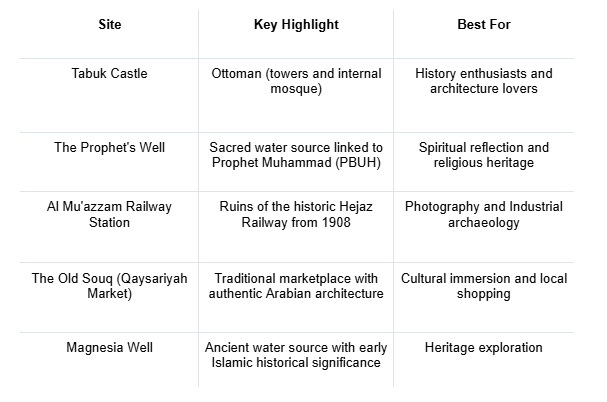
Top 5 Heritage Sites to Visit in Tabuk: Quick Guide
Final Words
Explore the significant history and how vision 2030 in especially crafted Umrah Packages UK, as it is about to transform your visit whether you are a history lover, or a spiritual explorer, knowing about Tabuk and its legacy will provide you with a better insight into the soul of the region that has been preserved throughout the ages. We will open the secrets of this gateway with you. Discover some of the important insights of the formation and expedition of the Tabuk, explore some of the most remarkable archaeological discoveries like the Ottoman empire and their heritage through the inscriptions of pre-Islamic era.
HOW DO YOU FEEL ABOUT FASHION?
COMMENT OR TAKE OUR PAGE READER SURVEY
Featured



Windows do far more than frame a view.