
The Rise of Machine-to-Machine (M2M) Payments: How AI Agents are Quietly Rewiring the Global Economy

PAGE
By PAGE Editor
Imagine driving into a parking garage, finding a spot, and leaving an hour later without ever needing to reach for your wallet or phone. While you were shopping, your car negotiated a rate with the parking structure’s digital system and authorized a micro-transaction the moment you exited. This is not science fiction; it is the dawning reality of the Machine-to-Machine (M2M) economy. We are rapidly moving away from a world where every financial transaction requires human approval to one where devices transact independently on our behalf.
This shift represents a fundamental transformation in how value moves across the globe. For decades, the digital economy has focused on making it easier for humans to buy things, streamlining checkout processes to a single click. Now, the paradigm is shifting toward removing the human from the loop entirely for routine tasks. Smart devices, empowered by artificial intelligence, are becoming economic agents capable of buying, selling, and negotiating, creating a layer of commerce that operates silently in the background of our daily lives.
The Evolution of Transactional Autonomy
To understand our trajectory, we must look at the evolution of payments from cash to digital wallets, driven by a relentless demand for speed. Today, the priority is minimizing friction. Modern interfaces allow users to engage instantly, whether navigating a streaming service or placing a wager at Vulkan Bet casino with just a few taps. M2M payments take this concept of "invisible payments" further by removing human interaction entirely. This transition relies on robust infrastructure, such as blockchain, which provides a secure and immutable record for autonomous transactions. By combining AI decision-making with cryptographic security, we are building a trustworthy financial nervous system for the Internet of Things.
How AI Agents Serve as Economic Proxies
In this new economic model, AI agents act as proxies for human desires and financial constraints. These are not merely programmed scripts that execute a recurring payment; they are intelligent software entities capable of evaluating context. An AI agent managing a smart home, for example, wouldn't just pay the electricity bill; it would monitor real-time energy prices, switch consumption to off-peak hours, and even sell excess solar energy back to the grid when prices are high.
These agents operate based on parameters set by their human owners, ensuring that autonomy does not equate to a loss of control. The beauty of this system lies in its ability to handle volume and complexity that would overwhelm a human. An AI can negotiate thousands of micro-transactions per day—such as paying for data usage by the megabyte or road usage by the meter—creating a fluid, pay-as-you-use economy.
Key capabilities of AI economic agents include:
Autonomous Negotiation: The ability to communicate with other machines to agree on price and terms based on pre-set preferences.
Micro-transaction Management: Handling fractions of a cent efficiently, making business models like "streaming payments" viable.
Contextual Decision Making: Analyzing environmental data (like time, demand, or supply) to determine the optimal time to execute a transaction.
Resource Allocation: Automatically purchasing supplies or maintenance services before a breakdown occurs.
Transforming Industries from the Ground Up
The implications of M2M payments extend far beyond smart homes and personal convenience. Entire industries are poised for disruption as assets become capable of monetizing themselves. In the logistics sector, autonomous trucks could pay for their own fuel and toll fees, while shipping containers could negotiate their own priority handling based on the urgency of their cargo. This level of automation promises to extract unprecedented efficiency from global supply chains.
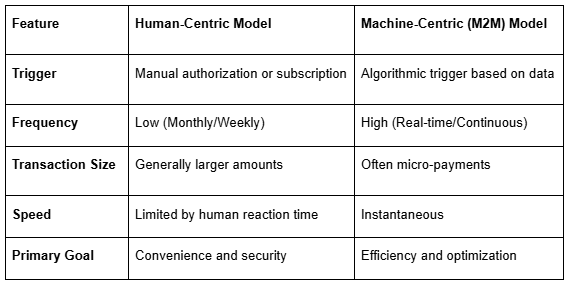
Furthermore, the manufacturing sector stands to gain immensely from the integration of M2M financial flows. Machines on a factory line could order their own replacement parts or bid for raw materials in real-time marketplaces. This reduces downtime and ensures that inventory levels are optimized dynamically rather than relying on static forecasts. To visualize the impact, it is helpful to compare traditional payment models with the emerging machine-centric approach.
Comparison of Human-Centric vs. Machine-Centric Models:
Navigating the Challenges of an Automated Economy
Despite the immense potential, the rise of M2M payments brings significant challenges that must be addressed. Security is paramount; if a washing machine has a digital wallet, it becomes a potential target for cybercriminals. Ensuring the integrity of these AI agents is crucial to preventing unauthorized spending or the manipulation of market prices by rogue algorithms. Additionally, there are questions regarding liability—if an AI agent makes a poor financial decision, who is responsible?
Trust is another major hurdle. Consumers must feel comfortable delegating financial authority to software. This requires transparent reporting mechanisms that allow users to audit the decisions their devices are making. Just as we review a bank statement today, we will likely need "agent logs" that explain why a device chose to buy a specific brand of detergent or charge a car at a specific station.
Embrace the Autonomous Financial Future
As we stand on the brink of this economic revolution, it is clear that the definition of a "customer" is expanding to include machines. The convergence of AI and digital finance is creating a world where value flows as freely as information. For businesses and consumers alike, the key to thriving in this environment will be adaptability and a willingness to embrace automation.
To stay ahead of this curve, start by evaluating how your current interactions with technology can be streamlined. Whether you are a business leader looking to optimize supply chains or a consumer interested in smart home technology, the M2M revolution offers tools to save time and resources.
HOW DO YOU FEEL ABOUT FASHION?
COMMENT OR TAKE OUR PAGE READER SURVEY
Featured





Larry June transformed Oakland into the cultural epicenter of football’s biggest weekend, as Family Style Food Festival fused food, fashion, and community through the exclusive Larry’s Table experience and high-impact brand collaborations spanning Cash App, Square, Häagen-Dazs, Lexus, Discover Puerto Rico, and Complex.