
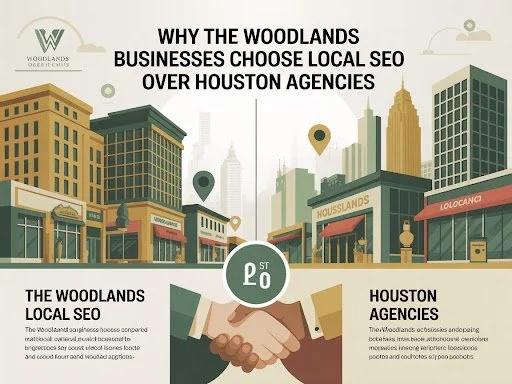
Why The Woodlands Businesses Choose Local SEO Over Houston Agencies
PAGE
By PAGE Editor
If you're running a business in The Woodlands and searching for SEO near me The Woodlands, you've probably noticed something: your search results are flooded with Houston agencies.
Big names. Slick websites. Promises of "dominating Google."
But here's what most business owners in The Woodlands figure out pretty quickly—Houston agencies don't really get The Woodlands market. And that gap? It costs you customers.
The Houston Agency Problem Nobody Talks About
I talked to a friend who runs a successful HVAC company off of Research Forest Drive last month. He'd been working with a well-known Houston SEO agency for almost a year. On paper, everything looked great. They sent monthly reports. His rankings were "improving." The dashboard had lots of green arrows.
But his phone wasn't ringing any more than it did before.
When we dug into what the Houston agency was actually doing, the problem became obvious. They were optimizing his Google Business Profile for "Houston." They were building citations that listed his business in Houston directories. They were targeting keywords that people in Spring and Cypress were searching for—not people in The Woodlands.
The agency wasn't being malicious. They just treated The Woodlands like it was another Houston suburb. Which, if you live here, you know is completely wrong.
The Woodlands isn't a suburb. It's a master-planned community with its own identity, its own economy, and its own way of doing business. People here don't search for "HVAC repair Houston." They search for "HVAC repair The Woodlands" or "AC service near me"—and they expect results that actually understand where they live.
What Makes The Woodlands Different (And Why It Matters for SEO)
Let's be real: The Woodlands operates differently than Houston.
You've got Town Center as your commercial hub, not downtown Houston. You've got The Woodlands Mall, Market Street, Hughes Landing. Your customers are shopping, eating, and looking for services in those areas—not in the Galleria or Midtown.
When someone in The Woodlands searches for a plumber, they're not looking for someone based in Katy or Pearland. They want someone who can get to their house off Kuykendahl or Gosling without sitting in an hour of traffic on I-45.
And here's the thing about local SEO: Google knows this too.
Google's algorithm prioritizes proximity. If your business is listed with a Houston address, or your website content is built around Houston keywords, you're actively telling Google you serve Houston—not The Woodlands. Even if you're ten minutes away in Shenandoah or Oak Ridge North, you're getting beat by businesses that have properly optimized for The Woodlands as their primary market.
A good SEO agency near me The Woodlands understands that nuance. A Houston agency treating you like client #247? Not so much.
The "Near Me" Search Reality
Here's something most business owners don't realize: "near me" searches have absolutely exploded in the last few years. And they're not going away.
When someone in The Woodlands pulls out their phone and searches "landscaper near me" or "dentist near me," Google is serving results based on three things:
Proximity – How close is your business to the person searching?
Relevance – Does your online presence clearly indicate you serve The Woodlands?
Prominence – How well-known and reviewed is your business in the local area?
If a Houston agency is managing your SEO, they're likely missing #2 entirely. They're not optimizing your Google Business Profile for The Woodlands-specific searches. They're not building local citations in Woodlands-area directories. They're not creating content that mentions Research Forest, Panther Creek, or Grogan's Mill.
They're doing generic Houston SEO and hoping it works for you.
It doesn't.
I've seen this firsthand working with businesses that switched from Houston agencies to a local approach. One client—a med spa in the Village—was ranking on page three for "med spa The Woodlands." After refocusing the entire SEO strategy around hyperlocal Woodlands optimization, they hit the top three within four months. Not because we had some secret trick, but because we actually understood their market.
We knew their clients live in Alden Bridge and Sterling Ridge. We knew they compete with businesses on Research Forest and Woodlands Parkway, not Westheimer. We knew the local search behavior, because we're in the local market.
What Local SEO Actually Looks Like in The Woodlands
If you're comparing agencies right now, here's what you should be asking them:
Do they know the difference between optimizing for The Woodlands vs. optimizing for Houston?
A real inbound agency The Woodlands should be able to explain how they'll target The Woodlands specifically—not just tack your ZIP code onto a Houston strategy.
Are they building local citations in the right places?
Your business should be listed in The Woodlands-area directories, chambers, and community sites—not just Yelp and Yellow Pages. There are local business groups, Woodlands-specific platforms, and regional resources that Houston agencies don't even know exist.
Do they understand your competition?
Your competitors aren't in downtown Houston. They're on Rayford Road, Sawdust, and Gosling. A good local SEO strategy analyzes what they're doing and finds opportunities to outrank them where it actually matters.
Are they creating content that speaks to Woodlands residents?
Blog posts about "Houston home services" don't resonate with someone living off of Six Pines. Content should mention local landmarks, neighborhoods, and the specific concerns of Woodlands homeowners and business owners.
Why Alpha Lead Marketing Works Differently
Look, I'm not going to sit here and tell you we're the only agency that can do SEO. There are talented people everywhere—including Houston.
But what we do differently at Alpha Lead Marketing is simple: we focus on Texas markets like The Woodlands because we know them. We're not trying to serve clients in 50 states. We're not running a cookie-cutter national SEO program.
We work with businesses that need to show up when someone in The Woodlands searches SEO near me The Woodlands, or "plumber near me," or "best roofer in The Woodlands." We build strategies around the specific search behavior of people in this market.
And honestly? That's what works.
When a potential customer is comparing you against two other local businesses, the one that shows up higher in "near me" searches wins. The one whose Google Business Profile is dialed in for The Woodlands wins. The one that has reviews from people in Creekside Park and Indian Springs wins.
We've helped HVAC companies, roofers, med spas, attorneys, and even a local bakery do exactly that. Not by running some massive ad budget or gaming the system—just by doing local SEO the right way.
What You Should Do Next
If you're a business owner in The Woodlands and your current SEO isn't working, it's probably not because SEO doesn't work. It's because whoever's running it doesn't understand your market.
Here's my suggestion: ask your current agency (or any agency you're considering) these questions:
Can you show me how you've helped other businesses rank specifically in The Woodlands?
How do you optimize for proximity-based searches?
What local citations and directories are you targeting for my business?
Do you understand the competitive landscape in The Woodlands vs. Houston?
If they give you vague answers or start talking about "overall Houston rankings," you know what you're dealing with.
And if you want to talk to someone who actually knows this market, we're here. You can find us by searching for a The Woodlands SEO agency that focuses on getting Texas businesses found by the customers who actually matter—the ones nearby.
Because at the end of the day, that's what local SEO is supposed to do. Get you found by people in your area who are ready to buy.
Not someone in Katy. Not someone in Sugar Land.
Someone in The Woodlands. Right now. Looking for exactly what you offer.
HOW DO YOU FEEL ABOUT FASHION?
COMMENT OR TAKE OUR PAGE READER SURVEY
Featured




As fashion faces mounting regulatory demands and data overload, the 25-year-old bluesign system is emerging as the industry’s foundational infrastructure by providing the verified, process-level data that today’s traceability platforms and digital product passports depend on.